AI Ethics Implementation for Aotearoa New Zealand
Aotearoa's National AI Strategy aligns with the OECD AI Principles, but responsible implementation requires more than international standards. Organisations operating here must also honour Treaty of Waitangi obligations, uphold Maori data sovereignty, and safeguard cultural safety for Maori and Pacific communities.
We help organisations weave together these dual foundations -- global best practice and te ao Maori values -- into ethics frameworks that are practical, measurable, and culturally grounded.
Why Standard Ethics Frameworks Fall Short in Aotearoa
International AI ethics guidance was not designed for a bicultural nation with Treaty obligations and indigenous data sovereignty requirements
Algorithmic Bias Hits Indigenous Communities Hardest
AI systems trained on data that underrepresents or misrepresents Maori and Pacific peoples produce outcomes that deepen existing inequities. Credit scoring, welfare eligibility, healthcare triage, and predictive policing models have all demonstrated disparate impacts on indigenous populations globally. In Aotearoa, where systemic disparities are well documented, this risk demands specific attention beyond generic fairness testing.
No Prescriptive Ethics Law -- But Growing Expectations
New Zealand has no mandatory AI ethics code. Adoption is voluntary. But the Privacy Commissioner, Human Rights Commission, and sector regulators increasingly expect organisations to demonstrate responsible AI practices. The gap between "no legal mandate" and "no consequences" is narrowing. Organisations that wait for prescriptive requirements will find themselves retrofitting ethics into systems already in production.
Treaty Obligations Are Not Optional
Te Tiriti o Waitangi creates specific obligations around partnership, protection, and participation that extend to how organisations collect, use, and make decisions with data about Maori. AI systems that process whakapapa data, health information, or social service records involving Maori engage these obligations directly. A responsible AI framework that ignores Treaty principles is incomplete by definition.
Two Foundations for Ethical AI in Aotearoa
Our approach integrates OECD AI Principles -- New Zealand's adopted international benchmark -- with te ao Maori values that reflect the unique ethical obligations of operating in a Treaty-based nation
OECD AI Principles (International Foundation)
New Zealand's National AI Strategy explicitly aligns with the OECD Recommendation on AI, establishing these as the country's ethical benchmark for responsible AI development and deployment.
- Inclusive growth and sustainable development -- AI should benefit people and the planet
- Human-centred values and fairness -- respect human rights, democratic values, and diversity
- Transparency and explainability -- meaningful information about AI systems
- Robustness, security, and safety -- manage risks throughout the AI lifecycle
- Accountability -- organisations answerable for proper functioning of AI systems
Te Ao Maori Ethical Principles (Cultural Foundation)
These values drawn from te ao Maori provide a culturally grounded ethical lens that ensures AI systems respect the unique context of operating in Aotearoa.
- Kaitiakitanga (guardianship) -- stewardship responsibility for data and systems that affect communities
- Mana (authority and prestige) -- preserving the dignity and self-determination of individuals and groups
- Whakapapa (genealogy and interconnection) -- understanding data as relational, not merely transactional
- Tika (correctness) -- ensuring processes and outcomes are fair and just
- Manaakitanga (care and reciprocity) -- upholding care for those affected by AI decisions
AI Ethics Implementation Services for Aotearoa
Maori Data Sovereignty and Cultural Impact Assessment
Structured assessment of how AI systems interact with data about or from Maori, applying Te Mana Raraunga principles to identify sovereignty risks and cultural safety gaps before systems go live.
- Data provenance mapping for Maori and Pacific data sets
- Cultural safety analysis for AI outputs and recommendations
- Engagement framework for iwi and mana whenua consultation
- Sovereignty-compliant data governance recommendations
Equity-Focused Bias Testing for AI Ethics Implementation
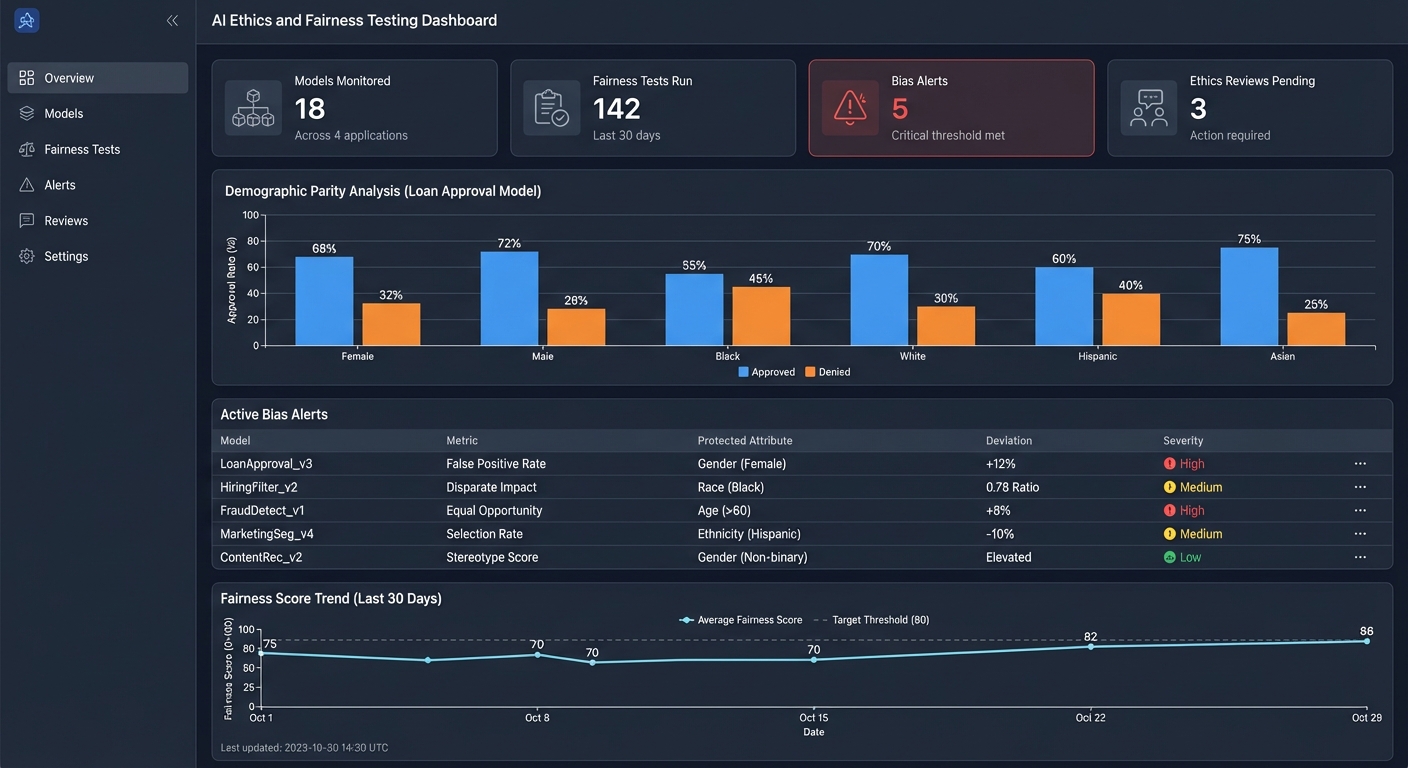
Fairness testing with specific attention to outcomes for Maori, Pacific peoples, and other communities that experience systemic disadvantage. Goes beyond standard demographic parity to test for proxy discrimination through variables like postcode, language, and surname.
- Disparate impact analysis across ethnicity, age, disability, and other Human Rights Act 1993 grounds
- Proxy variable identification targeting indirect ethnic discrimination
- Intersectional analysis for compounded disadvantage
- Ongoing monitoring framework with equity-specific triggers
OECD-Aligned AI Ethics Implementation Framework
Comprehensive organisational ethics framework that translates OECD AI Principles into operational policies, integrates Treaty obligations, and establishes governance structures appropriate for your sector and risk profile.
- Responsible AI policy mapped to OECD principles and Treaty obligations
- Ethics committee charter with cultural competency requirements
- Ethical review decision criteria and escalation pathways
- Public Service AI Framework alignment (for government agencies)
Transparency and Explainability Design
Design and implementation of explanation mechanisms that meet Privacy Act 2020 transparency requirements and provide culturally appropriate communication about AI decision-making to affected individuals and communities.
- Explainability techniques (SHAP, LIME) calibrated to audience
- Plain language disclosure meeting Privacy Act 2020 Principle 3
- Human review and appeals pathways for automated decisions
- Culturally appropriate explanation formats for diverse communities
What You Receive
Tangible deliverables grounded in New Zealand's regulatory and cultural context, not generic templates
AI Ethics Policy
Organisational policy mapping OECD principles and Treaty obligations to your specific operations and AI use cases
Maori Data Sovereignty Assessment
Analysis of data practices against Te Mana Raraunga principles with remediation recommendations
Bias Testing Report
Equity-focused fairness analysis with outcomes disaggregated by ethnicity, age, disability, and other protected grounds
Ethics Committee Charter
Governance structure with cultural competency requirements, decision criteria, and escalation pathways
Explainability Implementation
Technical and communication solutions for transparent AI decision-making meeting Privacy Act 2020 requirements
Ongoing Monitoring Framework
Continuous fairness monitoring, outcome tracking, and periodic review processes with equity-specific metrics
Common Questions
Why use OECD AI Principles instead of developing our own?
New Zealand's National AI Strategy explicitly aligns with the OECD Recommendation on AI, making these principles the country's adopted international benchmark. The OECD framework provides interoperability with trading partners and international standards while allowing organisations to layer on Treaty obligations and te ao Maori values specific to Aotearoa. This dual approach gives you internationally recognised foundations without losing cultural specificity.
What is Maori data sovereignty and how does it apply to our AI systems?
Maori data sovereignty, as articulated by Te Mana Raraunga (the Maori Data Sovereignty Network), asserts that data about Maori people, language, culture, resources, and environments is a taonga (treasure) subject to Maori governance. For AI systems, this means organisations should consider who controls data about Maori, how it is used in training models, whether Maori have been consulted on its use, and whether AI-derived insights are shared back with the communities they concern. We help operationalise these principles proportionate to your use case.
Is AI ethics implementation mandatory in New Zealand?
There is no mandatory AI ethics code in New Zealand. However, existing laws create binding obligations that overlap significantly with ethical AI practices. Privacy Act 2020 requires transparency about data collection and use. The Human Rights Act 1993 prohibits discrimination. The New Zealand Bill of Rights Act 1990 protects fundamental rights. For public sector agencies, the Public Service AI Framework establishes clear expectations. Voluntary adoption now reduces risk and positions organisations well as regulatory expectations develop.
How do you test for bias affecting Maori and Pacific peoples specifically?
Standard fairness testing often fails to detect discrimination against smaller populations because statistical methods lose sensitivity with smaller sample sizes. We use techniques designed for this challenge: proxy variable testing (postcode, surname, language as proxies for ethnicity), counterfactual testing with culturally informed scenarios, intersectional analysis examining compounded disadvantage, and outcome monitoring with equity-specific thresholds. Where direct ethnicity data is unavailable, we use established statistical estimation methods with appropriate privacy safeguards.
How long does an ethics implementation engagement take?
A single AI system ethical review takes 4-6 weeks. Comprehensive ethics framework development typically requires 10-16 weeks, including stakeholder engagement. Organisation-wide implementation programmes span 6-12 months. Engagements involving iwi consultation require timeframes that respect tikanga processes, which we build into project planning from the outset. We scope each engagement to your specific context and priorities.
Begin Your AI Ethics Implementation Journey in Aotearoa
International principles provide the foundation. Treaty obligations and te ao Maori values provide the context. Together, they create an ethics framework that is both globally credible and culturally grounded. We help you implement both.
Initial review identifies ethical risks, Treaty obligations, and practical next steps for your organisation