Model Governance for Data Science Teams and APRA-Regulated Entities
Independent validation, risk management frameworks, and monitoring infrastructure that satisfy regulatory expectations whilst enabling data science innovation.
Serving data science teams, model risk managers, and financial institutions across Australia with practical model governance that balances control with operational efficiency.
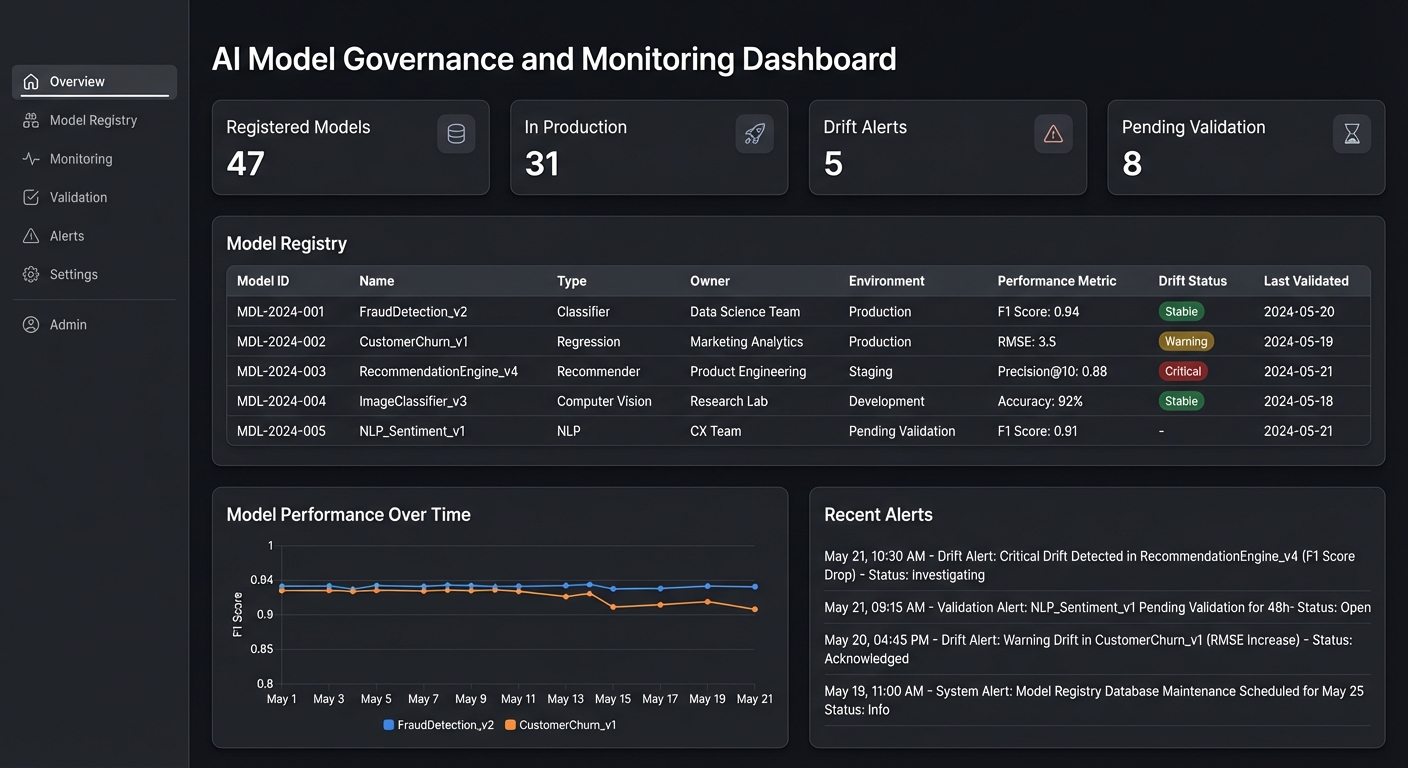
The Model Governance Gap
Your organisation has deployed models that make material decisions. Under APRA CPS 230 and broader prudential expectations, you must demonstrate appropriate governance, validation, and monitoring.
No Model Inventory
Models proliferate across data science teams, analytics functions, and business units without central oversight. Where is your complete register of models? Which models support critical operations? Which are high-risk requiring enhanced governance?
Inadequate Validation
Data science teams validate their own models. APRA expects "effective challenge" through independent validation. For high-risk models, who provides genuine independence? Do your validators have appropriate qualifications?
Missing Monitoring
Models degrade over time. Input data distributions shift. Relationships evolve. How do you detect performance degradation? What alerts when model drift occurs? Without monitoring, failures occur silently until business impact.
Independent Model Risk Management Services
Comprehensive model governance services for Australian organisations requiring regulatory-grade validation and risk management frameworks
Model Governance Framework Development
Comprehensive model risk management framework aligned to APRA prudential expectations and adapted to your organisation's model landscape.
- Model risk management policy
- Development lifecycle standards
- Independent validation methodology
- Governance committee structure
Model Inventory Development
Discovery and cataloguing of existing models across your organisation, with risk classification and documentation gap analysis.
- Comprehensive model discovery
- Risk classification by materiality
- Documentation gap assessment
- Prioritised remediation roadmap
Independent Model Validation
Objective validation of models before production deployment or as part of periodic revalidation cycles.
- Conceptual soundness assessment
- Data quality and performance validation
- Bias and fairness testing
- Comprehensive validation report
Model Monitoring Framework Design
Infrastructure and procedures for ongoing model performance monitoring and drift detection.
- Input and performance monitoring
- Drift detection (PSI, CSI)
- Three-tier alerting framework
- Fairness monitoring
APRA Prudential Compliance Assessment
Gap analysis against APRA's model risk management expectations with specific remediation recommendations.
- Model inventory assessment
- Validation approach review
- Governance structure effectiveness
- Board reporting templates
Financial Services Focus
Specialist expertise in financial services model types and APRA supervisory expectations.
- Credit risk scorecards
- Fraud detection algorithms
- Insurance pricing models
- Investment portfolio models
Tailored to sector requirements
Why Organisations Choose Our Model Governance Services
APRA and Regulatory Expertise
We maintain deep knowledge of APRA's supervisory expectations for model risk management. Our frameworks reflect current regulatory practice, not theoretical ideals disconnected from supervisory reality.
Technical and Risk Capabilities
Model governance requires both data science expertise and risk management experience. Our team combines hands-on model development background with model risk management practice. We validate models because we understand how they're built.
Independence Without Conflicts
We provide objective validation without software vendor affiliations or conflicts of interest. Our recommendations prioritise model risk management effectiveness, not product sales.
Practical Implementation
Our frameworks are designed for real organisations with existing data science teams, legacy systems, and operational constraints. We balance regulatory compliance with practical implementation.
Common Questions About Model Governance
Do all models require independent validation?
Risk-based approach: high-risk models require full independent validation before production deployment and periodic revalidation (typically annual). Medium-risk models require standard validation with less frequent revalidation (biennial). Low-risk exploratory models may receive light-touch review. Risk classification considers financial materiality, customer impact, regulatory sensitivity, and model complexity.
What happens if a model doesn't pass validation?
Validation determination options: Satisfactory (approved for production), Satisfactory with Conditions (approved subject to specific requirements such as enhanced monitoring or usage restrictions), or Unsatisfactory (not approved, requires remediation). Unsatisfactory determination triggers remediation plan development, model revision, and revalidation.
Can our data science team validate their own models?
First-line validation by development teams is appropriate for initial quality assurance. However, APRA expects "effective challenge" through independent validation for material models. Independence means validators are separate from the development team, have no conflicts of interest, and provide objective assessment. For high-risk models, external validation provides the strongest independence.
How do we know if our model governance meets APRA expectations?
APRA's prudential framework establishes practice expectations, not binary compliance requirements. APRA assesses whether your model risk management framework is appropriate for your institution's size, complexity, and model risk profile. Note that CPG 234 specifically covers information security management; model risk governance is addressed through broader prudential expectations including CPS 230 operational risk requirements. Key indicators: comprehensive model inventory, risk-based governance approach, independent validation for material models, ongoing monitoring infrastructure, clear accountability structures, board oversight of model risk.
Establish Model Governance That Satisfies Regulatory Expectations
If your organisation deploys models that make material decisions, you require appropriate governance, validation, and monitoring infrastructure.
Initial assessment includes review of current model inventory, validation practices, and regulatory requirements