AI Ethics Implementation Services
Implement Australia's 8 AI Ethics Principles and the Voluntary AI Safety Standard. We help organisations move from aspirational ethics statements to measurable, defensible practices.
Serving ethics officers, governance teams, and compliance managers requiring practical implementation of responsible AI frameworks.
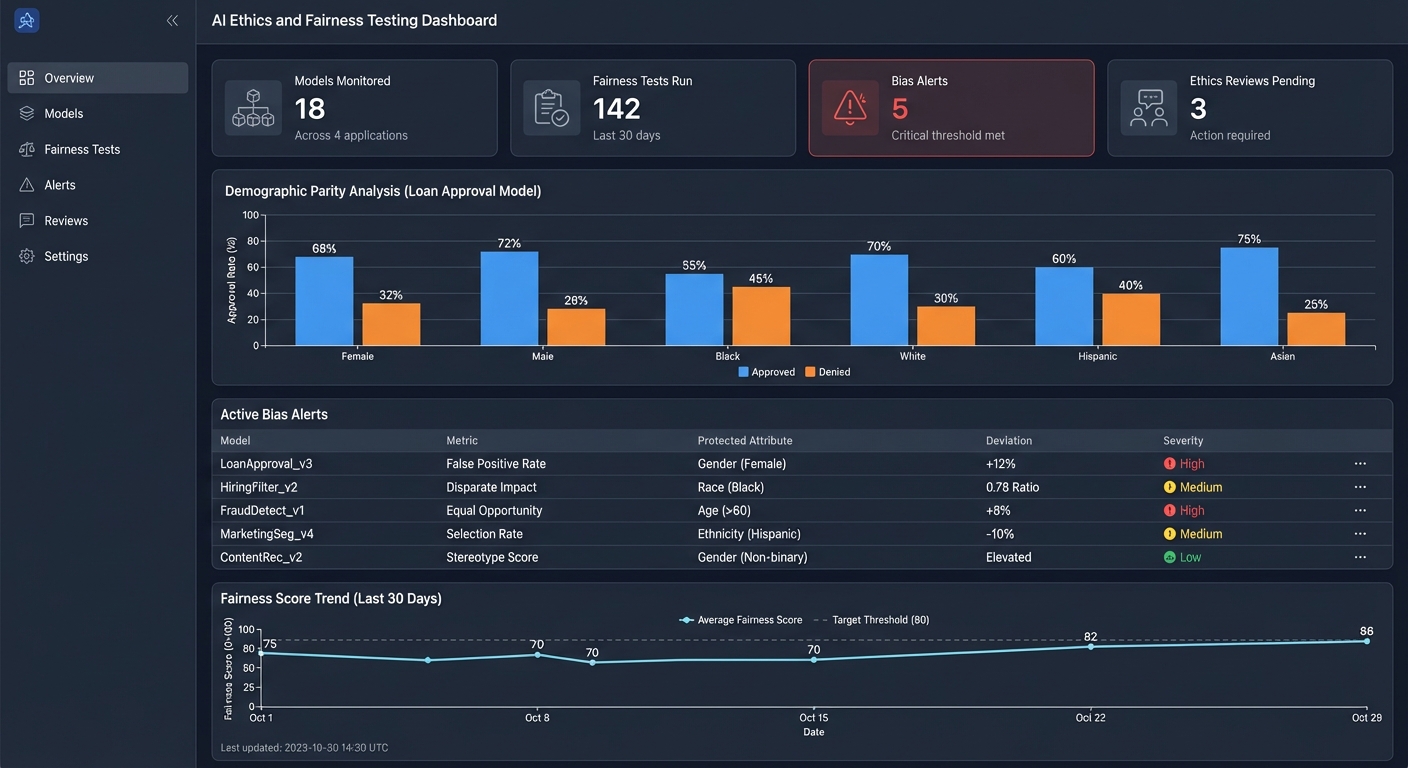
The Gap Between Ethics Principles and Practice
Many organisations express commitment to responsible AI but lack concrete measures to implement ethical principles
Discrimination Risk Without Fairness Testing
Your AI systems make decisions about credit, employment, insurance, and services. Without fairness testing, you cannot know whether outcomes vary inappropriately across protected attributes. Proxy variables create indirect discrimination that traditional quality assurance doesn't detect.
Opaque AI Decision-Making
Customers, regulators, and affected individuals increasingly demand explanations for AI decisions. "The algorithm decided" is not an acceptable answer. From 10 December 2026, Privacy Act amendments require disclosure of automated decision-making and human review mechanisms.
Voluntary Framework Available
The Voluntary AI Safety Standard (September 2024) establishes expectations for responsible AI. While currently voluntary, organisations implementing these practices demonstrate commitment to ethical AI and prepare for potential future regulatory developments.
Australia's 8 AI Ethics Principles
Developed by the Australian Government, these principles provide the ethical foundation for responsible AI use
1. Human, Societal and Environmental Wellbeing
AI systems should benefit individuals, society, and the environment throughout their lifecycle.
Implementation: Impact assessments considering benefits and harms across stakeholder groups, environmental sustainability considerations, ongoing monitoring of societal impacts.
2. Human-Centred Values
AI systems should respect human rights, diversity, and the autonomy of individuals.
Implementation: Human rights impact assessment, cultural diversity testing, autonomy preservation in AI-assisted decision-making, accessibility considerations.
3. Fairness
AI systems should be inclusive and accessible, and should not involve or result in unfair discrimination.
Implementation: Bias testing across protected attributes, proxy variable analysis, disparate impact measurement, demographic parity assessment, ongoing fairness monitoring.
4. Privacy Protection and Security
AI systems should respect and uphold privacy rights and data protection, and ensure security.
Implementation: Privacy impact assessment, data minimisation, purpose limitation verification, security controls proportionate to sensitivity, de-identification where appropriate.
5. Reliability and Safety
AI systems should reliably operate in accordance with their intended purpose.
Implementation: Robustness testing, failure mode analysis, graceful degradation design, ongoing performance monitoring, incident management procedures.
6. Transparency and Explainability
There should be transparency and responsible disclosure to ensure people understand AI decisions.
Implementation: Model documentation, explainability mechanisms (SHAP, LIME), layered explanations for different audiences, transparency reporting, disclosure of AI use.
7. Contestability
When AI significantly impacts people, there should be a timely process to allow challenges.
Implementation: Appeals procedures, human review mechanisms, escalation pathways, decision review processes, documentation supporting contestability.
8. Accountability
Those responsible for AI systems should be identifiable and accountable.
Implementation: Clear accountability mapping, audit trails, governance frameworks, incident response procedures, regulatory notification protocols.
AI Ethics Implementation Services
Bias Assessment and Fairness Testing
Systematic testing of AI systems for discriminatory outcomes across protected attributes including race, sex, age, disability, and other legally protected characteristics.
- Statistical parity and disparate impact analysis
- Proxy variable identification and testing
- Counterfactual fairness assessment
- Demographic parity and equal opportunity metrics
Explainability Implementation (XAI)
Implementation of explainable AI techniques to provide meaningful explanations of AI decision-making to different audiences including customers, regulators, and internal stakeholders.
- SHAP (SHapley Additive exPlanations) implementation
- LIME (Local Interpretable Model-agnostic Explanations)
- Layered explanations for different audiences
- Explanation interfaces and documentation
Ethics Framework Development
Comprehensive AI ethics framework aligned with Australia's 8 AI Ethics Principles and the Voluntary AI Safety Standard, tailored to your organisation's context and risk profile.
- Responsible AI policy and principles
- Ethics committee structure and charter
- Ethical review procedures and decision criteria
- Implementation roadmap and success metrics
Algorithmic Impact Assessment
Structured assessment of AI systems against the 8 AI Ethics Principles, identifying ethical risks, stakeholder impacts, and remediation requirements.
- Impact assessment against each principle
- Stakeholder identification and impact analysis
- Risk classification and mitigation recommendations
- Board-ready assessment reports
Voluntary AI Safety Standard - 10 Guardrails
We help organisations implement the Australian Government's voluntary standard in preparation for mandatory requirements
Accountability and Responsibility
Risk Management
Data Protection
Testing and Assurance
Human Control
Transparency
Contestability
Supply Chain Transparency
Record-Keeping
Stakeholder Engagement
Common Questions About AI Ethics Implementation
Are Australia's 8 AI Ethics Principles mandatory?
The 8 AI Ethics Principles are voluntary guidance, not legal requirements. However, they increasingly influence regulatory expectations, procurement requirements, and industry standards. Government agencies face mandatory requirements. Voluntary implementation now prepares organisations for potential future mandates.
How do we test for bias in AI systems?
Bias testing requires identifying protected attributes relevant to your use case, testing whether the AI uses protected attributes directly, analysing proxy variables that correlate with protected attributes, monitoring outcomes for disparate impact across demographic groups, and implementing bias mitigation techniques. We use industry-standard fairness metrics and statistical methods.
What is explainable AI (XAI) and why does it matter?
Explainable AI provides meaningful explanations of how AI systems make decisions. This matters for regulatory compliance, customer trust, internal understanding, bias detection, and legal defensibility. From 10 December 2026, Privacy Act amendments require disclosure of automated decision-making. We implement explanation techniques appropriate to your AI type and audience.
How long does ethics implementation take?
Implementation timelines vary by scope and organisational maturity. A single AI system assessment takes 4-8 weeks. Comprehensive ethics framework development takes 8-16 weeks. Organisation-wide implementation programmes typically span 6-12 months. We tailor engagement scope and timeline to your specific requirements and priorities.
Move from Aspirational Ethics to Measurable Practice
Many organisations express commitment to responsible AI but lack concrete implementation measures. We help you establish defensible practices aligned with Australia's 8 AI Ethics Principles and the Voluntary AI Safety Standard.
Initial assessment identifies ethical risks and recommends practical implementation steps